I did a lot of listening to audiobooks in 2024, especially while out and about on things like my daily walk that I do, but even just around the house or doom scrolling through social media, so I wanted to go through some of the books I listened to last year and which ones I enjoyed the most, these aren’t in any particular order; they’re just the ones I enjoyed listening to!
THIS IS A FAIR WARNING, FROM HERE ON OUT THERE MAY BE SPOILERS! DON’T SAY I DIDN’T TELL YOU. THIS IS ME TELLING YOU! POSSIBLE SPOILERS AHEAD!

First off we’re starting off with Devolution by Max Brooks. This is the first book by Max Brooks on this list, I really enjoy his books. This first book is kind of a “found-diary-cryptid-horror” if that makes sense (totally understandable if not!). There are elements of a “what if?” mystery thrown in for good measure.
The basic premise of the story is as follows, a group of people move into an isolated self-sustainable “eco-village” in Washington state in the USA close to Mount Ranier, (which for those who don’t know is a dormant volcano in real life) one day it erupts and strands the village, which lies just outside of the major damage zones but close enough to be cut off from it’s closest major transit routes. While they are awaiting rescue the village is attacked by a herd (family?) of Sasquatch AKA Bigfoot (Is Bigfeet the plural of Bigfoot). The story is told through the journals of one of the residents Kate, who have been handed to a reporter, and a series of interviews conducted with various people including a National Park Service Ranger and Kate’s brother Frank (voiced by the actor Nathan Fillion in this adaptation), who is searching for the truth about his sister and whether or not she is still alive.
The book does a good job of how even a small society of people can break down when disaster strikes and they lose access to all of their modern conveniences and amenities. The eco-village the characters live in, called “Greenloop” is supposed to be this off-the-grid but high-tech self-sustaining community, where all the house’s power and ecologically beneficial tech can be controlled through a tablet or computer and their groceries are delivered by drone or driverless electric vans. Once the characters lose all of that, they quickly fall into not trusting each other and being paranoid about each other.
The horror element of the book is ok too! It’s not going to give you nightmares. The tension remains consistent throughout the story as the characters try to figure out what to do about their attackers and argue about whether or not it’s worth trying to escape.
My one major frustration is that there is a plot hole in the story. It heavily implies that one of the characters has dealt with similar creatures in the past during one incident where the creatures are scared off by fire. It’s never really addressed by the other characters at all after that and is completely ignored as if it didn’t happen.
Otherwise, I thoroughly enjoyed it!
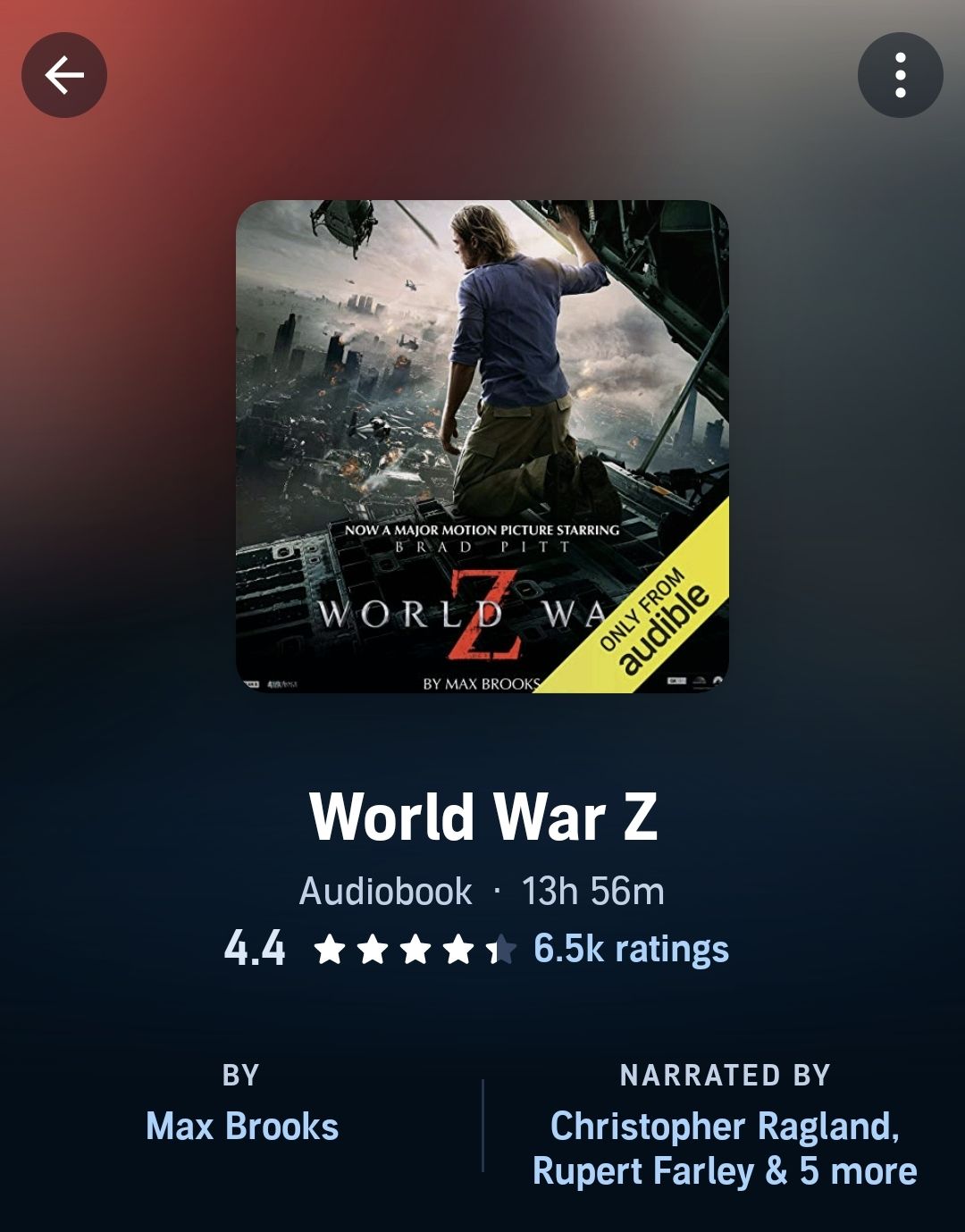
Up next is another Max Brooks book, one which got turned into a film starring Brad Pitt (the film is absolutely nothing like the book and that’s a shame, but that could be another blog post entirely). Honestly, this probably would have been a better TV show, but I think when the film came out there were already many Zombie Apocalypse TV shows. It’s also a shame that in this particular instance, they use the Movie tie-in cover on audible, as better, more interesting ones are available on the physical copies.
The Subtitle of this book is “An Oral History of the Zombie War,” which is exactly what it is. The story is told through a series of “interviews” with zombie war survivors and veterans. Humans have survived the Zombie Apocalypse (Barely!), and the world is slowly starting to get back on its feet. Through the interviews we learn about the various stages of how the apocalypse progressed, starting from its early outbreak and how the zombie virus spread globally through illegal immigration and black market organ donation, then as cases spread and gained public attention, how ordinary citizens and governments reacted and eventually caused, what the book refers to as “The Great Panic”. Eventually it describes how the plan to retake the earth was formulated and enacted and how it gradually worked it’s away across the world.
I found World War Z quite interesting, largely due to it being a “complete” story of the zombie apocalypse. What I mean by that in most zombie media whether it’s films, books or TV shows, most of the focus is on either the initial outbreak of a pandemic or the very early days of societal collapse. You very rarely learn what happens to humanity as a whole in these kinds of stories. Especially as most of these stories are America-centric, which World War Z is still guilty of to a degree.
Some of the other themes in this book are also quite interesting. With a look at things like government ineptitude in the face of a disaster, stemming from wanting to make themselves look better.
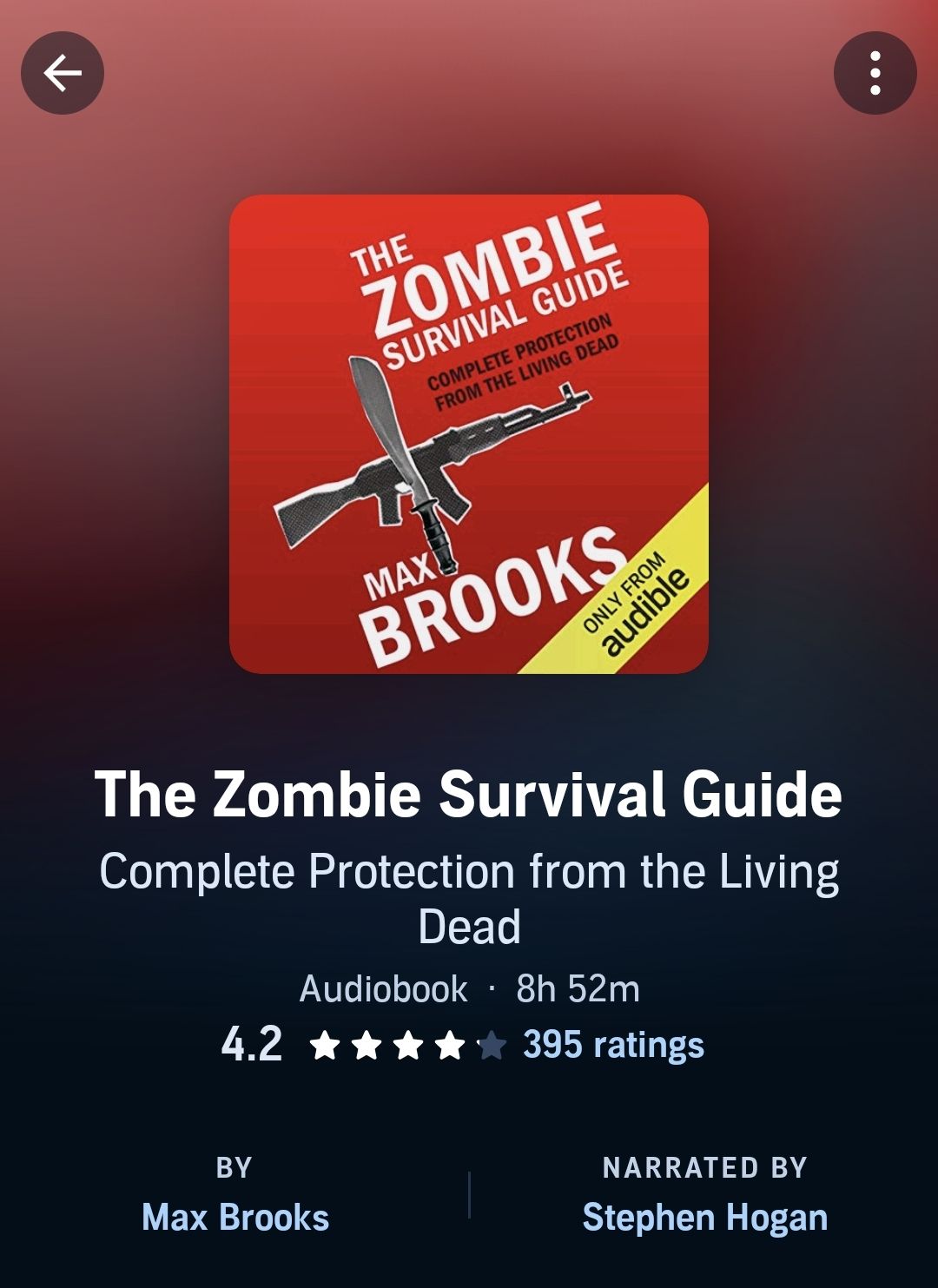
For the third book in a row, we have another Max Brooks book. This time it is The Zombie Survival Guide: Complete Protection from the Living Dead.
Now if you’re unlike me and have relatively normal daydreams or life plans and you don’t have a plan to survive the zombie apocalypse, this book is a reasonably good starting point. I say “starting point” because this book certainly reads with the mindset of an American citizen and how one might survive the return of the dead and, credit where credit is due, the book does admit to this biased viewpoint fairly early on in the introduction to the book.
The best thing about this book is the level of intricate detail covered for surviving a fictional event. Everything is covered from initial outbreak to surviving long term during the end of the world. This book is also set in the same “universe” as World War Z and even gets a brief mention in the third act, where again the author (through the voice of one of the characters) admits to the books bias towards American thinking. So if you ever want a new kind of escapism, where you might plan for the end of the world, I would definitely suggest starting here.
Although I enjoyed listening to The Zombie Survival Guide I do feel like it probably serves better in a physical form allowing for easier jumping forwards and backwards to read different sections from time to time. I think I lent my copy to someone but I can’t remember who.
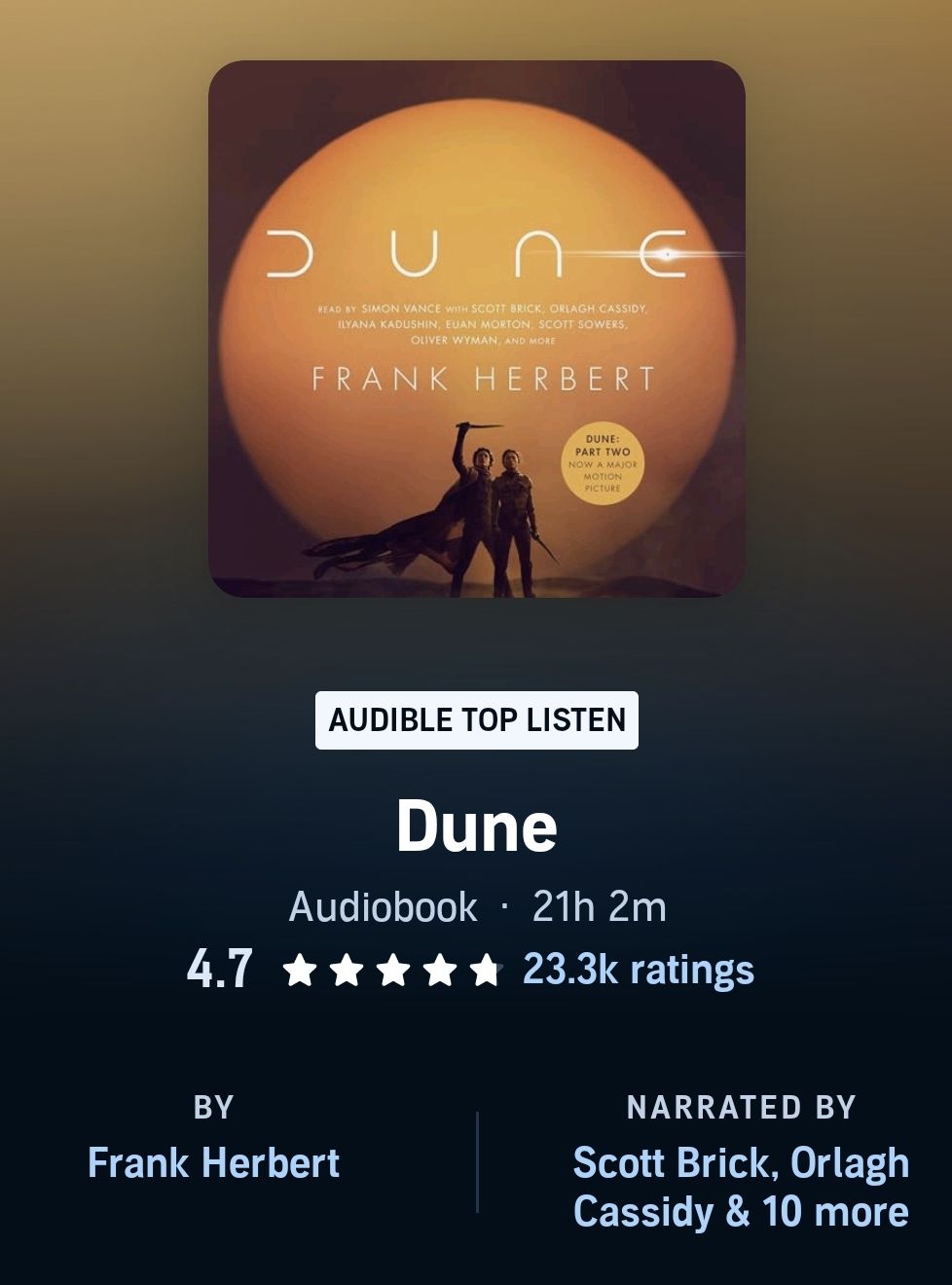
Moving on from Max Brooks’ bibliography, we arrive at a sci-fi classic Dune by Frank Herbert. I love Sci-Fi and have done so for years. As a teenager, I got into Warhammer 40K, and for those that may or may not know, Dune was one of the inspirations for Warhammer 40K. Having now finally listened to Dune, I certainly recognise some of the inspirations.
This was a bit of a slow burn, I found it.took a while to get going, but once it did, I really enjoyed it! There’s a lot of slow build tension paired with a good balance of fast and intense action.
Even at 24+ hours, I didn’t feel like it was overly long, unlike some of a similar length, which I’ve listened to, that can seem like a chore to listen too, or only really serve as background noise to trick my ADHD brain in to remaining on task.
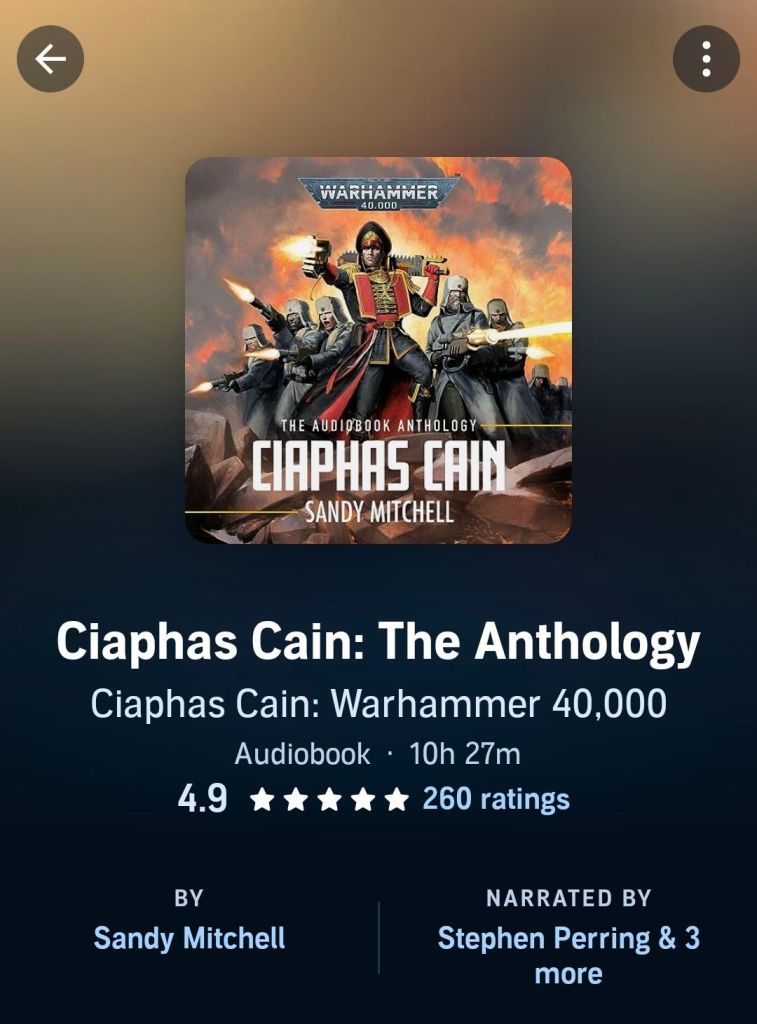
Seeing as I’ve mentioned Warhammer 40K, I’ll move on to Ciaphas Cain: The Anthology. The tone of this book surprised me a little, pretty much every book I’ve listened to from The Black Library (Games Workshops in house publishing house) are quite serious in tone but the Ciaphas Cain books are quite funny.
Most protagonists in Black Library novels are noble heroes trying to save humanity from the horrors of the 40k universe, whereas, Ciaphas Cain is only really trying to save himself, but just happens to do the right thing along the way.
I really enjoyed Ciaphas Cain as a character, he is quite different from most protagonists in Black Library books who tend to be the straight edged, stoic, noble hero types of characters. So to have a “hero” be a bit of a weasel, who is only looking to keep himself alive and keep his reputation intact, is interesting, it also helps that the book is written a little tongue in cheek and is really funny in places.
As this is an anthology, as you can imagine, it is more of a collection of short stories, rather than a continuous single story. Still I feel it sets up the character of Ciaphas Cain really well as well his Modus Operandi, which is exactly what you want from an anthology that also works as a prequel to the main series of books.

Moving on to the Ciaphas Cain series proper with the first book in the series, For the Emperor. Those who are familiar with the Warhammer 40k universe will be aware of who or what the emperor is, for those of you who aren’t, I’m not entirely sure what the most succinct way to describe them or what the imperium of man is, in the context of Warhammer 40k, but I will give it a go. The Imperium is a theocratic, fascist empire that stretches from Earth (known as Terra in Warhammer 40k) all the way to the edges of the milky way galaxy. The Emperor is an immortal, perpetual being (albeit severely wounded in the setting and being kept alive on a sort of life support) with some preternatural and supernatural powers, who despite all his protests, is seen as a god to the average citizen of the imperium.
Ciaphas Cain is a Commissar in the Astra Militarum (previously known as the Imperial Guard). A Commissar is what is known as a “political officer” in the Astra Militarum, they keep soldiers in line and hand out punishments where necessary, but they stand separate from the command structure, often being from a different world in the Imperium from the regiment they are inserted to, so they can monitor soldiers of all ranks and make sure they all tow the line of the Imperial Creed.
As mentioned previously, the Ciaphas Cain series is a bit lighter and funnier in tone than most books from the black library, which continues here, in the first full story in the series. This book was fully enjoyable and I always wanted to keep listening as much as possible. The cast of the book did a great job of encapsulating their respective characters.
Now that we’re into the fully fledged, stand-alone stories of the Ciaphas Cain series, you really get to see his character in full and how he keeps getting himself in and out of trouble over the course of a single story. Even though he might not be the traditional “hero” he is trying to do the right thing most of the time, even if it is in an attempt to follow the path of least resistance.
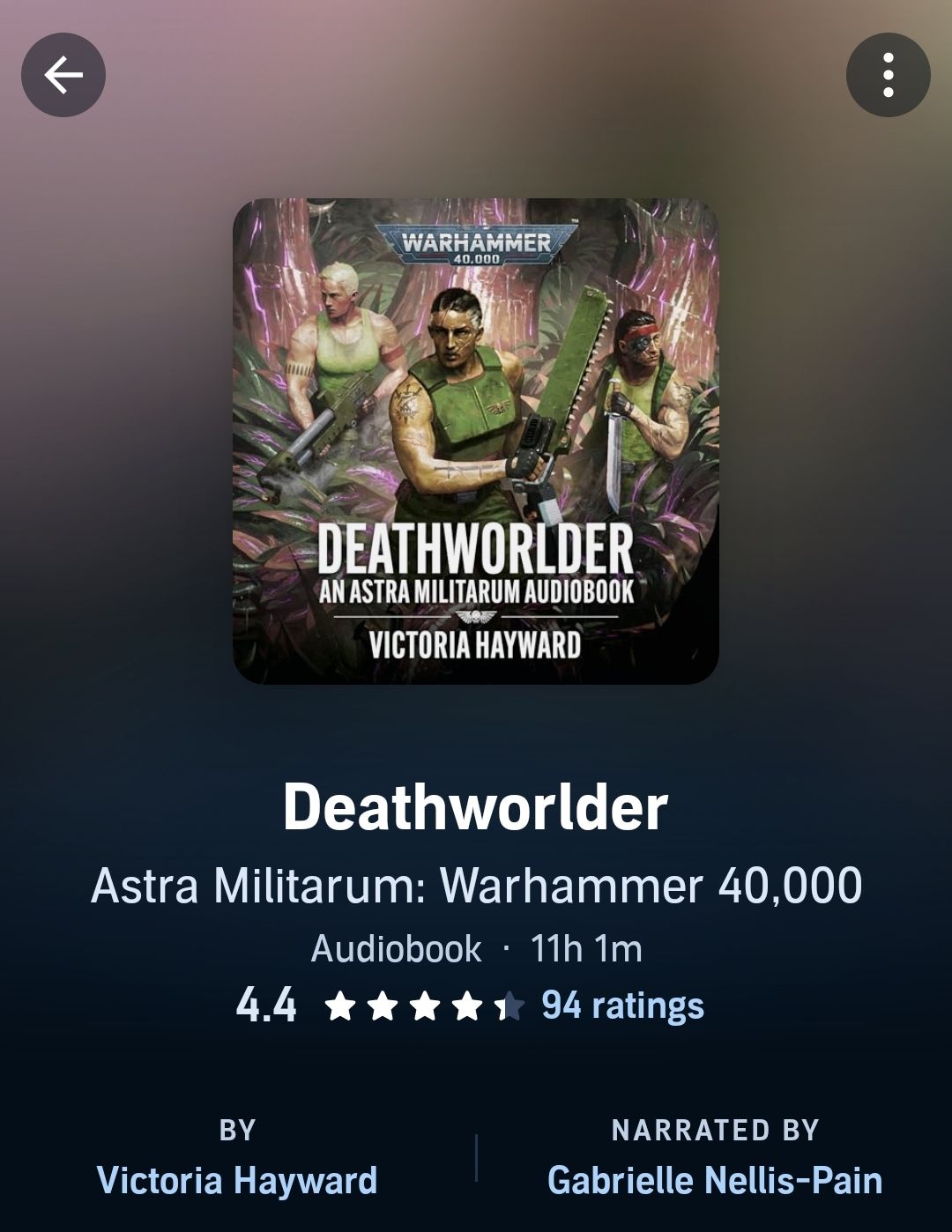
Deathworlder is another book following the Astra Militarum. This time, it’s one of the famous Catachan regiments under the microscope.
I like reading/listening to stories about the Astra Militarum because it shows what life is like for the “ordinary soldiers” in the Warhammer 40k universe, which is this vast, slightly jumbled and chaotic setting. With so much going on and the odds seemingly against the Astra Militarum as they struggle through a bit of a blender that is galaxy-wide, nonstop war.
The galaxy is full of weird and dangerous aliens, that might give some eldritch horror a run for their money, so to have these sorts of stories of ordinary humans fighting to protect humanity from the wider threats that they face is endearing. Warhammer 40k might notice I’ve got a bit of a soft spot for the Astra Militarum, and they would be absolutely correct.
In Deathworlder, we join the Catachan 903rd as they hold one final bastion against the Tyranids, an alien species controlled by a “hive mind” that devours everything biological to collect biomass to create more Tyranids. The story revolves around Major Wulf Khan, as she is ordered to take a squad of soldiers to investigate a possible weapon that many hope will be able to stop the inexorable consumption of the Tyranids. Although they discover that the weapon isn’t what they think it is, the journey to get to the facility where it is being held is fraught with danger and intensity, with many close calls along the way.
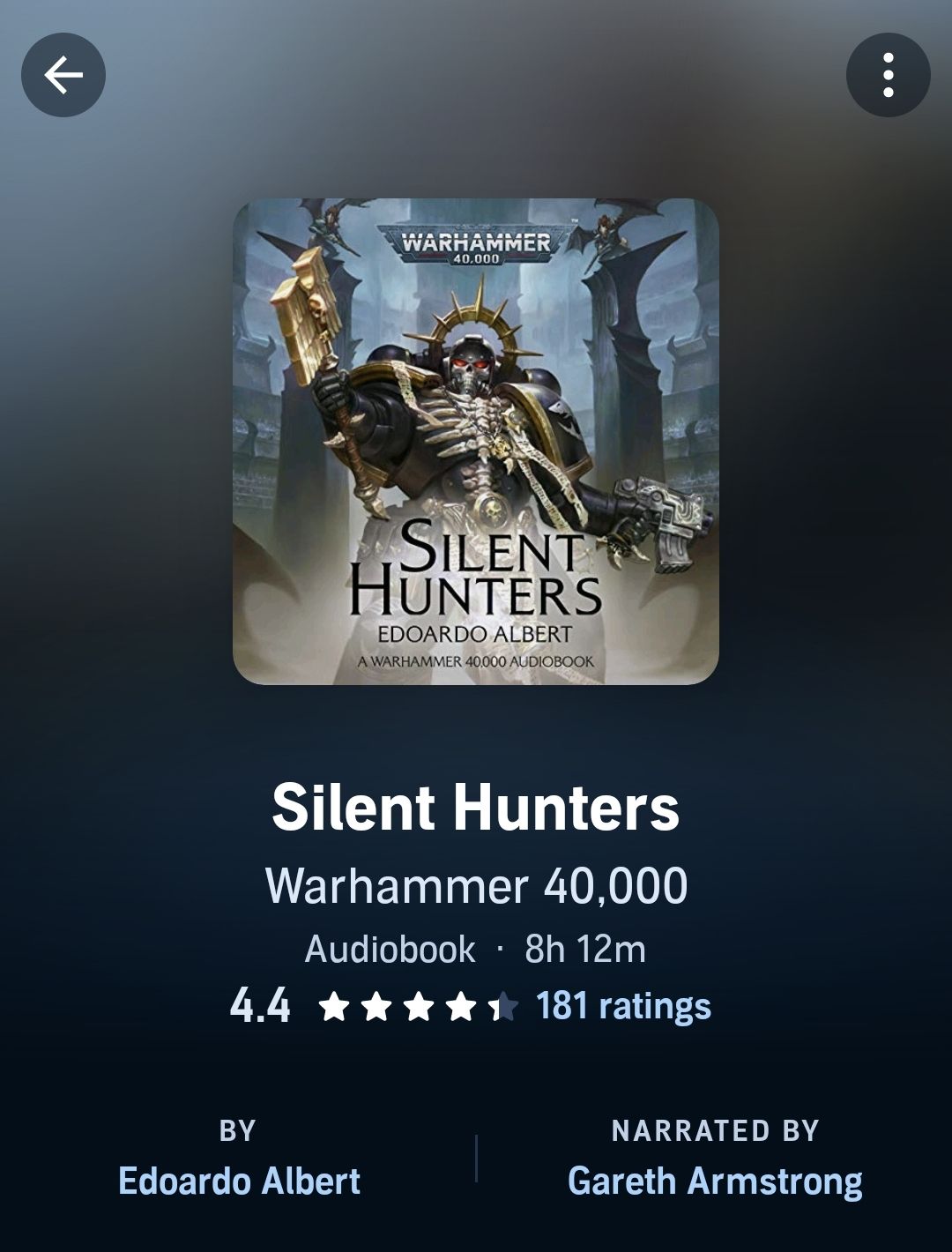
Now we move on to the Space Marines. These are the Imperium’s elite super soldiers. These genetically engineered and modified soldiers are giants among men, quite literally!
Space Marines are grouped together in “Chapters”, roughly 1000 marines in size, the Charcaradons are one such Chapter. A lot of Chapters are based on groups of people throughout history, the Charcaradons inspired by Pacific island Indigenous people, and many of their traditions are mirrored by the Space Marines.
At the start of Silent Hunters, an artefact of the Charcaradons is stolen and must be returned to the chapter. During their mission to retrieve their lost artefact, they stumble upon a young boy, being protected by his mother, who has unusual powers (in the Warhammer 40k universe, this is seen as a bad thing, sort of, it’s complicated). They must also travel through the Webway to find it. The Webway is an interdimensional transit system/realm/dimension of its own.
Anyway, before I get too lost in the rabbit hole that is the lore of Warhammer 40k, I’ll move on to why I enjoyed this book. The Carcharadons are a bit of a mystery in Warhammer 40k; their origins are a bit murky, and why they tend to stay to the fringes of space is semi-forgotten by time and history. Having that element of mystery is really intriguing, and the characteristics of the Charchadons and how they think and operate really drew me in, in a way that some other Space Marine Chapters don’t (a lot of them are a little bit “vanilla” or plain). They’re also not on some quest for repentance like other isolated Chapters often are; they were given a task and will only return to the fold when they have completed that task to their satisfaction.
The Carcharadons are also not as flamboyant and boisterous as other Chapters; they are stoic and quiet. They fight in complete silence, and that adds an element of unease which I find really interesting, because it breaks some of the in-universe stereotypes of how Space Marines are supposed to be.
In Silent Hunters, the Charcardons are up against the Drukhari (AKA Dark Eldar AKA evil space elves). They must travel to the city of Commoragh, in the webway, to retrieve something the Drukahri stole from them. The way they did this on their own with little to no outside help was quite resourceful, as they are often forced to be.
The characters are quite interesting, and how the Space Marines interact with the “normal” humans who tag along on their mission shows a different side to the Charcaradons.
The story has a good pace to it, and it doesn’t rely on a sort of “false jeopardy ” where it feels like the odds are too insurmountable, but they succeed anyway that is sometimes present in Warhammer40K stories. The Charcaradons come across as quietly competent and following and executing their plan.

The Charcaradons are known as a “Fleet-based Chapter”, meaning they don’t have a world to call home and tend to keep themselves to themselves on the fringes of known space. This means they have to perform ceremonies called the “Red Tithe” to collect more recruits to keep their numbers at an effective level and the “Grey Tithe” to collect resources like ammo and armour.
In Red Tithe, the Charcaradons must find new recruits. Their recruitment differs from other Space Marine Chapters due to the fact that they don’t have a “home world” to draw fresh recruits from, so they have to take them from planets in the imperium.
Their chosen planet this time round is a prison/mining planet called Zartak. Prisoners are forced to mine raw materials for the imperium. It is a planet they have tithed before, but this time, they have competition.
The Night Lords are traitor Space Marine Legion who turned their backs on the imperium 10,000 years ago. They have also come to Zartak for the same purpose, to recruit for their warband. There is also a more sinister plot as one of the warband wishes to summon a demon from the warp.
One particular prisoner is unaware of his importance to both the Charcaradons and the Night Lords, as his psyker abilities can swing the balance in favour of one side or the other. With both sides looking to acquire his abilities, he has to try and escape.
This was quite interesting to listen to as part of the Charcaradons’ mysterious beginnings are potentially tied to the Night Lords, and their fighting styles are similar. So, to have a crossover between the two and hear they compare head to head.
As I’ve said previously, I find the Charcaradons really interesting and Red Tithe adds to that as well learn more about how and why they operate the way that they do. Hearing about their motivations and justifications was cool, and the satisfaction of them overcoming the hurdles that they faced to achieve the goals was gratifying.

The final book on this list is another Charcaradons book. Yes, I went into a bit of a hyperfocus on the Charcaradons, I’m autistic. That’s what we do sometimes!
The Outer Dark has the Charcaradons facing up against the Tyranids, an alien race that is akin to a swarm of large carnivorous insects being led a central intelligence, called “The Hive Mind”, that consumes all biomass in order to create more Tyranids and to help them evolve new forms of Tyranids.
The Tyranids are one of the biggest threats to the galaxy in warhammer 40k as they wish to consume all life, but the Charcaradons have been fighting them for a long time and are experts at defeating them.
Up against a large splinter fleet of the Tyranids, the Charcaradons must decide when and where to set up a bulwark against the aliens to prevent them from eating and tearing their way through a large section of the galaxy. They must also decide if they should trust a fellow exiled chapter of Space Marines to offer aid when the time is right, based on old agreements and continued trade.
The planet they decide on is Piety V, a shrine world to the emperor of mankind. They believe the Tyranids will hit this world hard and use it as a springboard to delve deeper into imperial space. While preparing their defences and the population for the invasion, they discover a cult on Piety V that are set upon attracting the Tyranids towards the planet as quickly as possible.
The Charcaradons must act quickly to stamp out this insidious plot if they are to save the planet from being devoured. With the odds stacked against them planetside as the cult reveals just how deeply infiltrated the positions of power in the planets government and the fleet up in space growing larger and larger, The Charcaradons have to dig deep to buy themselves time, in the hopes that reinforcements turn up as promised.
In Outer Dark, I did feel it was a bit more tense, as there’s a lot going on, and there seemed to be a smaller guarantee of success for the Charcaradons without outside help, but did find the ending quite satisfying.
So there’s the list of audiobooks that I enjoyed last year. It’s taken me a bit longer to write this blog because I had to revisit some of them to remind myself of what happened in the books. But anyway, here it is finally! I hope you enjoy it.

 Duncan Ainsworth