Apparently today is the 14th anniversary of me signing up for wordpress!
I’ll admit I don’t post on here as often as I could or should. I often struggle with coming up with something other people might consider interesting. I feel as though I should be posting something thoughtful or interesting or funny, but then I think that’s all subjective and are people really all that interested in what I have to say?
There are plenty of bloggers out there who have better writing styles, who seem to be able to collect their thoughts more coherently than my ADHD verbal diarrhoea style of writing, which I imagine can sometimes be quite hard to follow.
I’m also aware I’m just another voice talking to (mostly) themselves on the the Internet, in the vague hope that someone may occasionally stop by to listen (or read in this case), for even a short while, as we make our way through the dopamine chasing maze of the modern day Internet/Social Media.
I don’t know if I’m setting too high a bar for myself, by thinking I need to be blogging something profound every time I post, or thinking I need to be some great orator to be accepted or taken seriously.
I am sometimes tempted to post just to vent what I’m feeling, but I worry those posts might really turn up the incoherent rambling to the maximum, as in typical ADHD/autism fashion I’m not very good at being able to describe how I’m feeling. Sometimes all I feel is blank.
(I just googled it and the term is Alexithymia, apparently it is a common Autism co-occuring condition.)
If anyone has any advice I would certainly appreciate it. I feel as though I ought to post more here but I’m intrigued by what would people actually want to read or if I should be a bit more comfortable with talking to the void of the Internet.
My gut instinct is to say I’m more of a night person, I can quite happily stay up to the small hours of the morning and sleep until late morning or early afternoon, but if you were to ask me to wake up at four or five in the morning to travel somewhere, or go to work, I could probably do it (very begrudgingly). Still, I probably wouldn’t be fully functional for at least a few hours.
I believe it is a common thing for people with ADHD, like myself, to have a delayed circadian rhythm, whereby our natural awake/sleep cycle is different from neurotypical folks. This means we tend to perform better in the afternoon, evenings and even late into the night.
There are different theories as to why this may be, from arguments suggesting an evolutionary or genetic cause. For example, back when humans needed people to guard caves from predators or to watch over herds of animals overnight, it was beneficial to have people who were less prone to dozing off while on duty. Genetically speaking, there may be differences in a person’s “clock genes”, which, combined with other biological factors such as when and how much of the hormone melatonin is released and Suprachiasmatic Nucleus (SCN) differences and the volume of the Pineal gland, can all contribute to an ADHD person’s sleep cycle.
Obviously, there are other factors too, such as environmental factors, such as stress and how much time we spend in front of a screen. Blue light can have an effect on a person’s circadian rhythm as it can alter a person’s melatonin production. Some people say, a busy environment means a busy mind, which may or may not be true in my case.
I can often get into a bit of a vicious cycle when it comes to the quality of sleep and my ADHD symptoms, which I’m learning as I write this blog, is a fairly common occurrence and has been researched. I’m probably in a bit of a self-destructive routine of going to bed late, then getting up late, then taking my meds late, and the cycle continues. That being said, I’ve mentioned a few times in videos on my YouTube that I actually prefer being up late than getting up early. The world is so much more peaceful and enjoyable at two a.m. than it is at most points during the day. I feel like there’s less pressure to perform or be someone that I’m not when everyone else is asleep.
I’ve got a Fitbit watch that “tracks” my sleep, and it quite regularly says that I get less than five hours of actual sleep a night (even if I’m in bed and not awake for eight hours or more), and most of that is in the lighter sleep phase, which would explain why I feel tired when I get up. Throw in a good dose of sleep apnea, and it’s no wonder my sleep pattern is more than a little wonky!
If anyone has any good sleep tips, though, they would be more than welcome! I see loads of adverts for various supplements, like “functional mushrooms” and different types of magnesium compounds, and they seem a bit of a “snake oil” situation. If I can avoid nonsense like that, that would be great!
I am currently learning to design games in Unreal Engine (UE) 5.6, and it has been an interesting challenge, but a challenge nonetheless. I’m a couple of months in, and I figured it’s about time to share some of the challenges I have faced while studying something I have wanted to do for a long time.
My first—and possibly my biggest — challenge was my own brain. Those of you who have read this blog before know that I have ADHD, specifically inattentive ADHD. I have trouble retaining instructions, especially if they are given to me verbally, which, due to the course being an online one, are delivered in video form. I am constantly struggling to keep up with what instructors are saying while trying to implement what they are saying at the same time. Watching the videos in one go also presents a problem because I have to watch the video multiple times to recognise what it is the instructors are actually asking me to do, or even remember what they’ve said, which, given that some videos are up to ten or fifteen minutes long, means I often spend hours trying to make the tiniest amount of progress and I find it infuriating.
I also find myself trying to bite off more than I can chew. I want to be able to try and do things beyond what I’m being taught, so I end up getting a bit lost and frustrated. I get a bit lost trying to make sure all the code I’m trying to implement works, as I have minimal coding experience, and it seems like the course is designed for people with some coding experience already.
I struggle to explain what I’m really trying to say here because it’s sometimes a case of “I don’t know what I don’t know”, if that makes any sense. That’s how confused I get by certain things, and the explanations offered by the “instructors” don’t help at all, as they are usually long-winded and waffly videos that don’t always get to the point. It also doesn’t help that the course is based on an outdated version of Unreal Engine, and some of the things that the instructors refer to are either in different places or no longer exist, which is incredibly annoying.
On the whole, though, it has been interesting and I feel like I have learned a lot. I certainly have a newfound appreciation for how games are made and how much work goes into making them. The level of detail in some games always blows me away, and having now had a peek behind the curtain into how they are made only increases my respect for the people who made them.
I want to keep getting better at this, and I’m determined to do so. I’ll keep plugging away and keep trying to create what I can, and naturally, I will eventually get better at it.
A little something I put together
One day, I’d love to create my own game! Maybe one day I’ll get there, but it’s best not to rush these things. A rushed game is never a good game. I will try to be patient and experiment, and learn as I go.
I was initially diagnosed with Depression in 2012. I had been struggling with it on and off for a while at that point, and it was the right time to seek help for it. I started medication not long after. I had been struggling with feelings of being suicidal and having no self-esteem or self, and didn’t see much point to being around.
Fast forward to now, I have been gradually reducing the amount of medication that I’ve been taking for a few months now and have been feeling ok with the reduction. I think the main driving factor in the change was starting to take ADHD medication, which has left me feeling more like myself and generally happier and with a brighter mood.
Getting diagnosed with ADHD has generally been a positive thing, as it is another way for me to understand myself better and how my brain works. I think in the two and a bit years since I was diagnosed with ADHD, there have been a few positive changes in my life which have all contributed to being less depressed.
I’m glad that I’m now in a place where I don’t depend on antidepressants to make me feel better, as I’ve been on them for over a decade. It feels right that, as I’m making positive changes in my life, I can rely on medication less. It feels like an important step to make in my mental health journey, even though they have helped me a lot over the years.
I don’t want this blog to sound like I’m saying antidepressants are bad or not suitable for me (or anyone else, for that matter), because they have helped me in many ways, as they help other people with their mental health. For me, it feels like the right time to be trying to move on and live life without them. They have been a useful tool over the past thirteen years, but now feels right to develop other tools to help keep my mental health in a more positive state.
I learned recently, on LinkedIn of all places, that this week (6th-12 October) is Dyspraxia Awareness Week, and as someone with Dyspraxia, I feel it’s only right that I celebrate it.
What is Dyspraxia?
Dypraxia, also known as Developmental Co-ordination Disorder (DCD), is a neurodevelopmental condition that can affect a person’s coordination and balance, as well as their ability to tie their shoelaces, complete tasks that require dexterity, such as holding small objects and writing with a pen or pencil. Dyspraxia does not affect a person’s intelligence, but it can affect how people learn. It is a condition that people are born with, not something you develop later in life
What causes Dyspraxia?
It’s generally unclear what causes Dyspraxia, as coordination is quite a complex process that involves many parts of the brain and nerves communicating with each other in certain ways. Although the causes are not entirely understood, there are a few things that could potentially increase the risk of a child being born with Dyspraxia, these include:
Being born prematurely (before the 37th week of pregnancy).
Being born with a low birth weight.
A family history of Dyspraxia/DCD (it’s unknown which gene in particular causes it).
The mother drinking alcohol or taking drugs while pregnant.
I was diagnosed with Dyspraxia at the age of 8. Growing up, I struggled with hand-eye (or foot-eye) coordination, particularly when playing sports. Spatial Awreness is also something I’ve struggled with, trying to work out how certain things fit together or how something would look in a certain space. I also didn’t learn to ride a bike until I was about 18, as the coordination and balance required were something I struggled with growing up.
I always struggled with handwriting in school; holding a pen or pencil made my hands hurt. I don’t know if I weirdly held them or not; maybe I did, and I wasn’t aware of it.
There is some overlap between Dypraxia and other Neurodivergent conditions, such as Autism and ADHD, but they are their own own conditions and you can have one and not the others.
If anyone has any questions about Dyspraxia, or what it’s like living with the condition, feel free to ask them!
I’m not sure what it is about the middle of the night that I find so appealing, but I find it to be the best time of the “day”. Maybe it’s my ADHD or Autism brain, but I always find the time between midnight and four or five AM to be peaceful and quiet in a way that seems to dissipate the stress I feel during “normal” operating hours. There’s something about the lack of activity or expectations from other people that soothes me. Additionally, with no one else using the internet, it seems to work more smoothly.
I don’t know how else to put it, really. There’s a certain sense of freedom to being awake when no one else is. I don’t often get to feel like that at any other time. I always feel like I’m moving to the beat of someone else’s drum or that I am living a life based on someone else’s milestones. There are no expectations of what you’re supposed to be
The quiet stillness of the world in the early hours of the morning is soothing. I think it’s part of the reason why I have discovered a love of stargazing. Not only because space is fascinating, but looking up at the night sky and having the time and the peace and quiet to well and truly enjoy what you are looking at is very satisfying.
Being awake when no one else is is one of the few times I feel inner peace and truly relaxed. No one wants or expects anything of me. That time is truly my own and no one else’s; it is one of the few times when I feel like I can be my real self and not what I think certain people want me to be.
I’ve seen other neurodivergent people express similar sentiments, so maybe it is an ADHD/Autism thing, I don’t know, but there’s just a lot less pressure to perform a certain way and to mask, because there isn’t anyone to mask for.
So those are a few reasons why the small hours of the night/early morning are my favourite time of day!
According to a quick Google search of the “etymology of the name Duncan” the name originates from the Scottish Gaelic name Donnchadh, which is derived from the Gaelic words “donn” (brown or dark) and “cath” (warrior) and it dates back to the 4th century. Other sources suggest it could mean “Dark Skinned Warrior”
So if I’ve got this right, I’m supposed to be some sort of dark/brown warrior. This might be the nerd in me coming to the fore, but it sounds like something out of a fantasy novel, or Dungeons and Dragons! Like I’m some mysterious fighter who stands up for those in need, dressed in leather armour and a bear skin pelt or something similar, wielding some sort of broadsword.
My Surname Ainsworth is based on the old English words for “own” and “homestead”, it’s also the name of a village near Manchester, England, and seems to be connected to where the names originates. It’s Anglo-Saxon in origins, and its first recorded use is a slightly different spelling with a man called William De Aynesworth.
The Ainsworth family motto is “Spero meliora” which is Latin for “Hope for the Better”. The family crest is three battle axes on a red shield or three spades on a blue shield with a gold edge.
Ainsworth family crest Ainsworth Family Crest 2
So there we have it, there’s a bit of history to my name. There’s all sorts of records for the name Ainsworth that you have to pay to access that go back in history.
What is autistic masking? In short, Masking is the conscious or unconscious efforts made by autistic people to hide or suppress their autistic traits and behaviours in order to fit in with Neurotypical (non-autistic) people.
There are many ways that autistic people masks and the majority of them require a lot of physical and mental energy to maintain and drain autistic people very quickly. It can also lead to mental health issues, including anxiety and depression. Masking can include things like, mentally scripting conversations (and if conversations go “off-script” it is usually very stressful for an autistic person), forcing eye contact and suppressing the urge to “stim”, which is how many autistic people emotionally regulate themselves (stimming is often a repetitive motion, such as rocking back and forth of hand flapping).
Attempting to mimic Neurotypical speech, facial expressions and behaviours, is also a common masking technique and can be draining for an autistic people, because it takes a lot of effort to maintain behaviours that they don’t understand or don’t do naturally, in an attempt to appear more “normal”.
Autistic people mask in order to be accepted by their peers and to fit in socially, despite the fact that it can cause burnout and mental health issues. Other issues can include a late diagnosis, as mentioned previously masking is not always a conscious process, so a person might have no idea that they are autistic and continue to struggle without knowing anything, because they have been led to believe that they’re struggles are normal and everyone struggles with similar things.
Masking may also lead people to believe that a person isn’t autistic as they spend so much time and energy pretending to be Neurotypical. It may also prevent a person from getting the support they need, as they come across as “High Functioning” or competent at looking after themselves.
Autistic people can feel a loss of self due to having to mask, as they are constantly having to change who they are in order to fit in with different social circles. This can be very stressful for autistic individuals because lacking a sense of self can be confusing and detrimental to their sense of worth and self-esteem.
As an autistic person I find Masking utterly exhausting, but having never really had a place where I could unmask safely, has meant that I no longer feel like I know who the real me is any more. I’m not even sure if I know who the “real me” is or ever was, and coming to that realisation at 35, this is somewhat distressing.
When I try to dig down into my feelings, I feel nothing, a blankness that I feel disconnected from. I feel like I don’t have my own identity, I am who I think others want me to be. I present myself differently to different people and leave no room for who I want to be by myself. I worry that have left it too late to undo the damage that that might have caused. I don’t know where to begin to try and unpick that knot.
I often feel isolated and disconnected because I don’t know who I’m supposed to be. I often feel like I have to shut down and be non-verbal for a while because it is easier than trying to figure out what I am feeling. It is very lonely as I feel like I don’t have anyone to relate to.
On a slightly lighter note, The National Autistic Society has some great information about masking at this link here:
Earlier this year I challenged myself to make more content for my YouTube channel, Beardo Bloggins. I decided to do this in the form of Daily Vlogs (Video Blogs), partly because they seemed easy to do, film different clips from the day and stitch them together and partly because I wanted to get more confident at appearing on camera. Now I’m closing in on 150 days of vlogging, and there are a few things I’ve learnt in that time.
First, some days are easier than others. I’ve found that some days are quite repetitive, so it often feels quite odd filming separate videos for them. I don’t really want to create content that feels too repetitive, recycling the same things day after day. Sometimes I feel like I’m stuck in a cycle of nothingness, and it’s a struggle to create content that people actually want to watch.
Second, when I originally started my YouTube channel, it was about explaining what life is like living with Autism, ADHD and Dyspraxia. I feel like I struggle to incorporate this kind of content into a vlog and highlight how a neurodivergent person goes about their daily lives, and I wonder if it’s a case of show and don’t tell or if I actively have to continually provide context for what I’m doing and why.
I definitely feel a bit more confident about speaking on camera, so at least I’ve ticked that box in regards to progression and achieving my goals, although I do tend to film more content at home rather than while I’m out and about rather than in public, because I don’t want to come across as the stereotypical obnoxious “influencer”/Content Creator who has to get content no matter what. I realise that other people don’t want to be filmed and are absolutely entitled to their privacy. I totally understand that a few bad actors have tarnished the image of content creation, with some of the “content” that they put out, “pranksters” and “Rage-Bait” content creators being two of the biggest offenders.
My next challenge that I want to do is to put out multiple types of content alongside the vlogs, whether it be videos about aspects of neurodivergent living like I was doing originally and maybe introducing Livestreaming regularly on platforms like Twitch or on YouTube, just to add a bit of variety as well as expanding my skillset with better video editing or “performing” live. I feel like I can still improve my content significantly, and now that I’m more confident with being on camera, now may be the time to do some experimenting.
Overall, I have been enjoying my content creation journey, and I definitely feel like there are more things to come, and I hope people will follow along and enjoy the things I do. I am very much looking forward to this journey, and I hope you are too! Check out my YouTube channel here and my Twitch channel here.
If you enjoy my content and want to support my journey, any donations would be greatly appreciated, as finding permanent work has been very difficult recently, and bills and other expenses have been rising. Obviously, this is not obligatory, and I certainly would never expect or demand any money from anyone. Sharing this post will also be a great way to help me out, so that will also be greatly appreciated!
I did a lot of listening to audiobooks in 2024, especially while out and about on things like my daily walk that I do, but even just around the house or doom scrolling through social media, so I wanted to go through some of the books I listened to last year and which ones I enjoyed the most, these aren’t in any particular order; they’re just the ones I enjoyed listening to!
THIS IS A FAIR WARNING, FROM HERE ON OUT THERE MAY BE SPOILERS! DON’T SAY I DIDN’T TELL YOU. THIS IS ME TELLING YOU! POSSIBLE SPOILERS AHEAD!
Max Brooks’ Devolution on Audible
First off we’re starting off with Devolution by Max Brooks. This is the first book by Max Brooks on this list, I really enjoy his books. This first book is kind of a “found-diary-cryptid-horror” if that makes sense (totally understandable if not!). There are elements of a “what if?” mystery thrown in for good measure.
The basic premise of the story is as follows, a group of people move into an isolated self-sustainable “eco-village” in Washington state in the USA close to Mount Ranier, (which for those who don’t know is a dormant volcano in real life) one day it erupts and strands the village, which lies just outside of the major damage zones but close enough to be cut off from it’s closest major transit routes. While they are awaiting rescue the village is attacked by a herd (family?) of Sasquatch AKA Bigfoot (Is Bigfeet the plural of Bigfoot). The story is told through the journals of one of the residents Kate, who have been handed to a reporter, and a series of interviews conducted with various people including a National Park Service Ranger and Kate’s brother Frank (voiced by the actor Nathan Fillion in this adaptation), who is searching for the truth about his sister and whether or not she is still alive.
The book does a good job of how even a small society of people can break down when disaster strikes and they lose access to all of their modern conveniences and amenities. The eco-village the characters live in, called “Greenloop” is supposed to be this off-the-grid but high-tech self-sustaining community, where all the house’s power and ecologically beneficial tech can be controlled through a tablet or computer and their groceries are delivered by drone or driverless electric vans. Once the characters lose all of that, they quickly fall into not trusting each other and being paranoid about each other.
The horror element of the book is ok too! It’s not going to give you nightmares. The tension remains consistent throughout the story as the characters try to figure out what to do about their attackers and argue about whether or not it’s worth trying to escape.
My one major frustration is that there is a plot hole in the story. It heavily implies that one of the characters has dealt with similar creatures in the past during one incident where the creatures are scared off by fire. It’s never really addressed by the other characters at all after that and is completely ignored as if it didn’t happen.
Otherwise, I thoroughly enjoyed it!
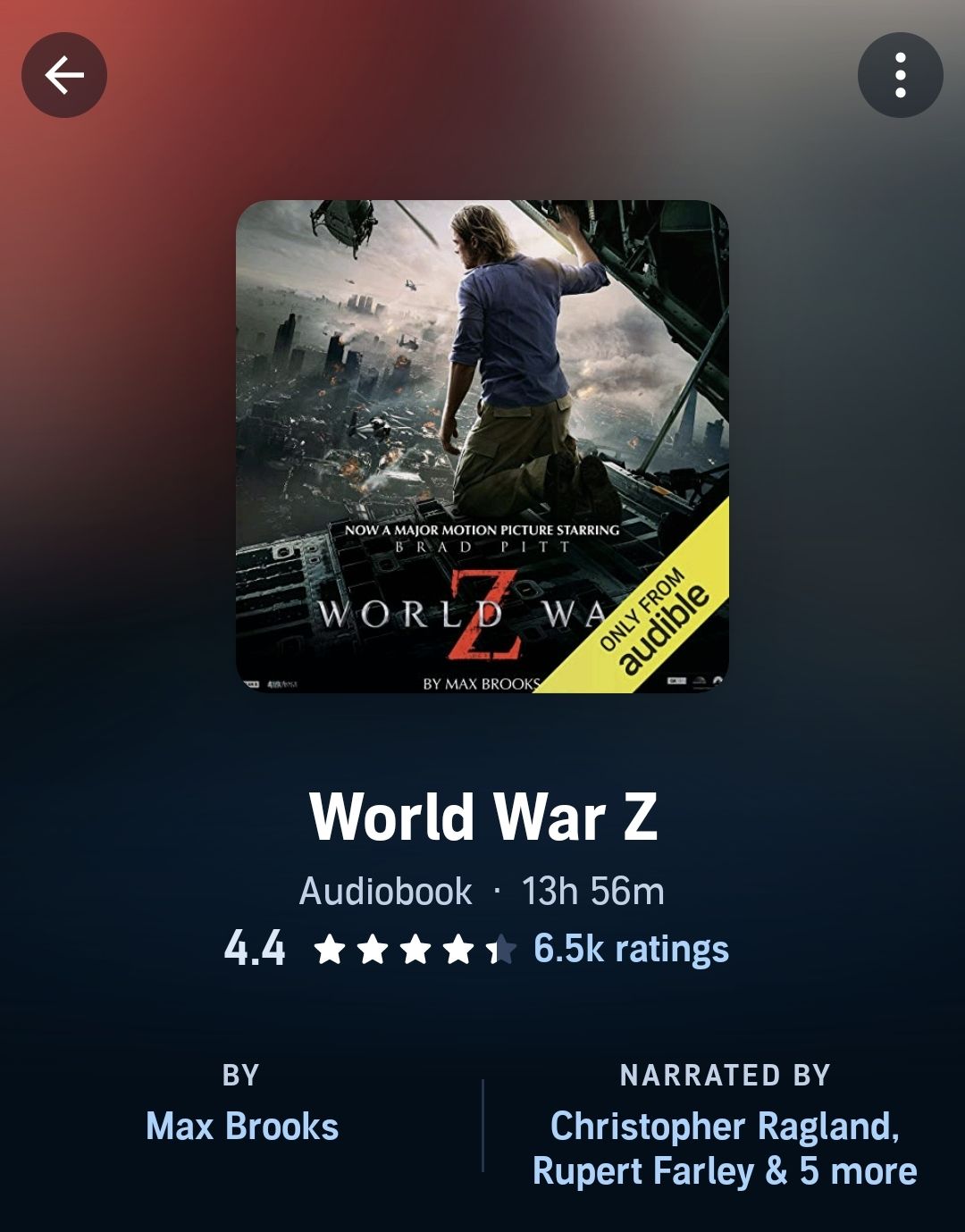
Up next is another Max Brooks book, one which got turned into a film starring Brad Pitt (the film is absolutely nothing like the book and that’s a shame, but that could be another blog post entirely). Honestly, this probably would have been a better TV show, but I think when the film came out there were already many Zombie Apocalypse TV shows. It’s also a shame that in this particular instance, they use the Movie tie-in cover on audible, as better, more interesting ones are available on the physical copies.
The Subtitle of this book is “An Oral History of the Zombie War,” which is exactly what it is. The story is told through a series of “interviews” with zombie war survivors and veterans. Humans have survived the Zombie Apocalypse (Barely!), and the world is slowly starting to get back on its feet. Through the interviews we learn about the various stages of how the apocalypse progressed, starting from its early outbreak and how the zombie virus spread globally through illegal immigration and black market organ donation, then as cases spread and gained public attention, how ordinary citizens and governments reacted and eventually caused, what the book refers to as “The Great Panic”. Eventually it describes how the plan to retake the earth was formulated and enacted and how it gradually worked it’s away across the world.
I found World War Z quite interesting, largely due to it being a “complete” story of the zombie apocalypse. What I mean by that in most zombie media whether it’s films, books or TV shows, most of the focus is on either the initial outbreak of a pandemic or the very early days of societal collapse. You very rarely learn what happens to humanity as a whole in these kinds of stories. Especially as most of these stories are America-centric, which World War Z is still guilty of to a degree.
Some of the other themes in this book are also quite interesting. With a look at things like government ineptitude in the face of a disaster, stemming from wanting to make themselves look better.
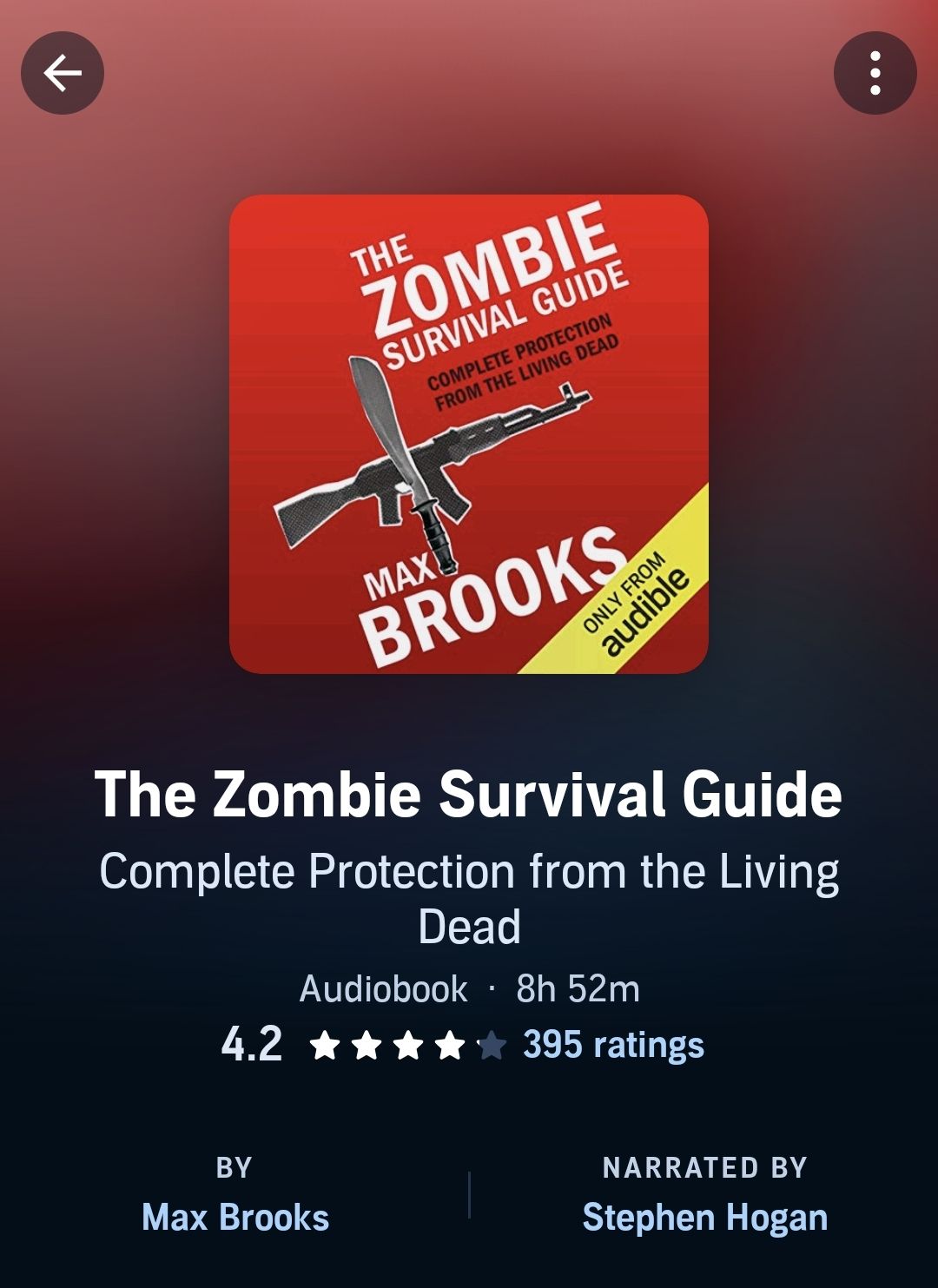
For the third book in a row, we have another Max Brooks book. This time it is The Zombie Survival Guide: Complete Protection from the Living Dead.
Now if you’re unlike me and have relatively normal daydreams or life plans and you don’t have a plan to survive the zombie apocalypse, this book is a reasonably good starting point. I say “starting point” because this book certainly reads with the mindset of an American citizen and how one might survive the return of the dead and, credit where credit is due, the book does admit to this biased viewpoint fairly early on in the introduction to the book.
The best thing about this book is the level of intricate detail covered for surviving a fictional event. Everything is covered from initial outbreak to surviving long term during the end of the world. This book is also set in the same “universe” as World War Z and even gets a brief mention in the third act, where again the author (through the voice of one of the characters) admits to the books bias towards American thinking. So if you ever want a new kind of escapism, where you might plan for the end of the world, I would definitely suggest starting here.
Although I enjoyed listening to The Zombie Survival Guide I do feel like it probably serves better in a physical form allowing for easier jumping forwards and backwards to read different sections from time to time. I think I lent my copy to someone but I can’t remember who.
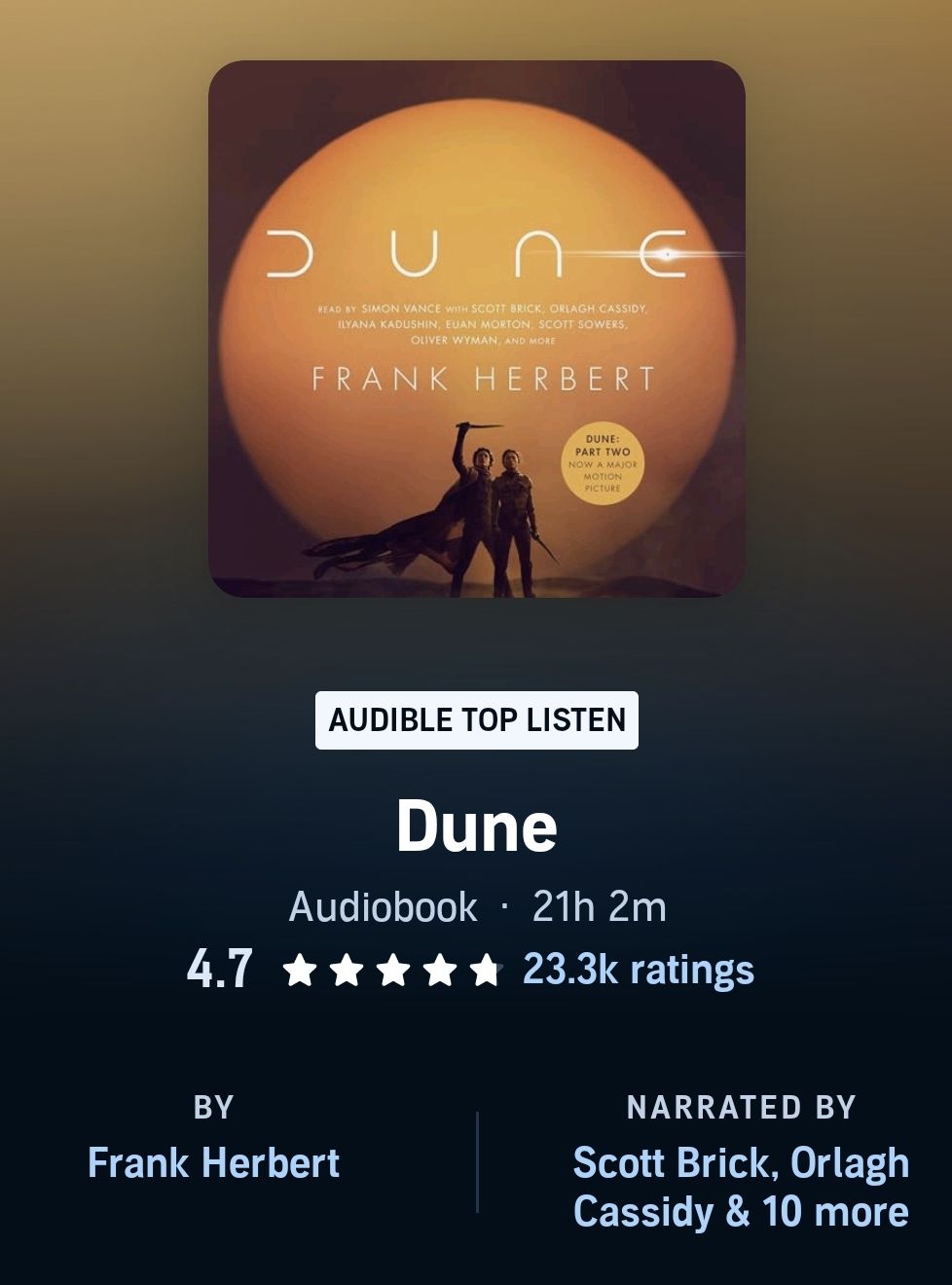
Moving on from Max Brooks’ bibliography, we arrive at a sci-fi classic Dune by Frank Herbert. I love Sci-Fi and have done so for years. As a teenager, I got into Warhammer 40K, and for those that may or may not know, Dune was one of the inspirations for Warhammer 40K. Having now finally listened to Dune, I certainly recognise some of the inspirations.
This was a bit of a slow burn, I found it.took a while to get going, but once it did, I really enjoyed it! There’s a lot of slow build tension paired with a good balance of fast and intense action.
Even at 24+ hours, I didn’t feel like it was overly long, unlike some of a similar length, which I’ve listened to, that can seem like a chore to listen too, or only really serve as background noise to trick my ADHD brain in to remaining on task.
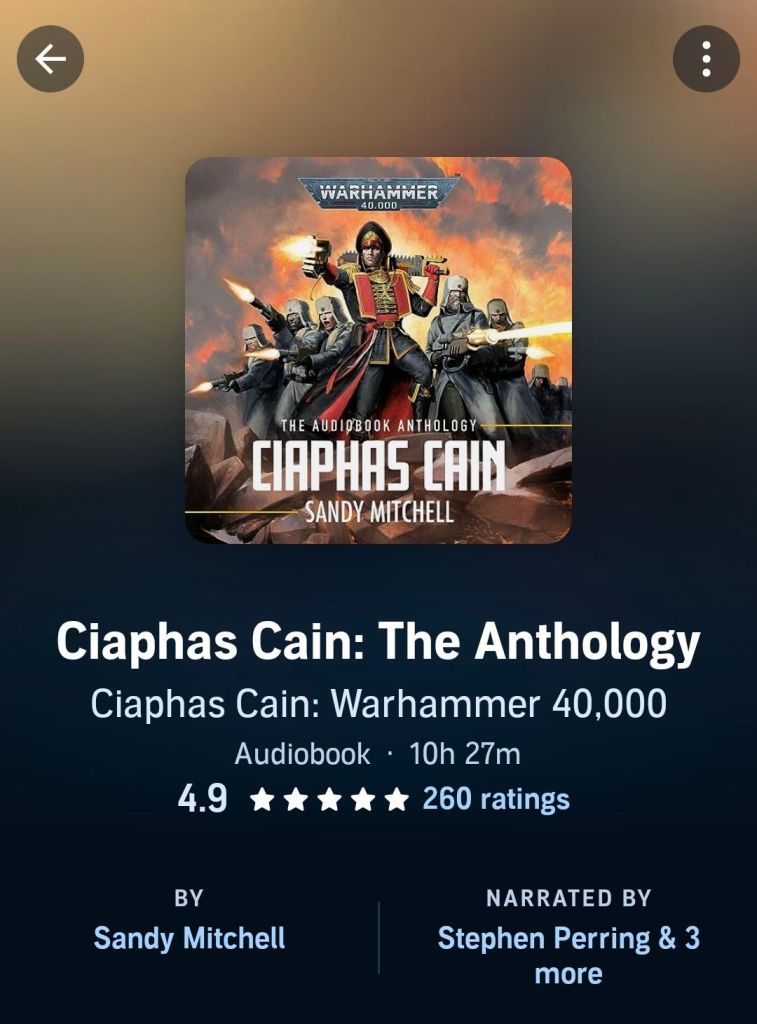
Seeing as I’ve mentioned Warhammer 40K, I’ll move on to Ciaphas Cain: The Anthology. The tone of this book surprised me a little, pretty much every book I’ve listened to from The Black Library (Games Workshops in house publishing house) are quite serious in tone but the Ciaphas Cain books are quite funny.
Most protagonists in Black Library novels are noble heroes trying to save humanity from the horrors of the 40k universe, whereas, Ciaphas Cain is only really trying to save himself, but just happens to do the right thing along the way.
I really enjoyed Ciaphas Cain as a character, he is quite different from most protagonists in Black Library books who tend to be the straight edged, stoic, noble hero types of characters. So to have a “hero” be a bit of a weasel, who is only looking to keep himself alive and keep his reputation intact, is interesting, it also helps that the book is written a little tongue in cheek and is really funny in places.
As this is an anthology, as you can imagine, it is more of a collection of short stories, rather than a continuous single story. Still I feel it sets up the character of Ciaphas Cain really well as well his Modus Operandi, which is exactly what you want from an anthology that also works as a prequel to the main series of books.
Moving on to the Ciaphas Cain series proper with the first book in the series, For the Emperor. Those who are familiar with the Warhammer 40k universe will be aware of who or what the emperor is, for those of you who aren’t, I’m not entirely sure what the most succinct way to describe them or what the imperium of man is, in the context of Warhammer 40k, but I will give it a go. The Imperium is a theocratic, fascist empire that stretches from Earth (known as Terra in Warhammer 40k) all the way to the edges of the milky way galaxy. The Emperor is an immortal, perpetual being (albeit severely wounded in the setting and being kept alive on a sort of life support) with some preternatural and supernatural powers, who despite all his protests, is seen as a god to the average citizen of the imperium.
Ciaphas Cain is a Commissar in the Astra Militarum (previously known as the Imperial Guard). A Commissar is what is known as a “political officer” in the Astra Militarum, they keep soldiers in line and hand out punishments where necessary, but they stand separate from the command structure, often being from a different world in the Imperium from the regiment they are inserted to, so they can monitor soldiers of all ranks and make sure they all tow the line of the Imperial Creed.
As mentioned previously, the Ciaphas Cain series is a bit lighter and funnier in tone than most books from the black library, which continues here, in the first full story in the series. This book was fully enjoyable and I always wanted to keep listening as much as possible. The cast of the book did a great job of encapsulating their respective characters.
Now that we’re into the fully fledged, stand-alone stories of the Ciaphas Cain series, you really get to see his character in full and how he keeps getting himself in and out of trouble over the course of a single story. Even though he might not be the traditional “hero” he is trying to do the right thing most of the time, even if it is in an attempt to follow the path of least resistance.
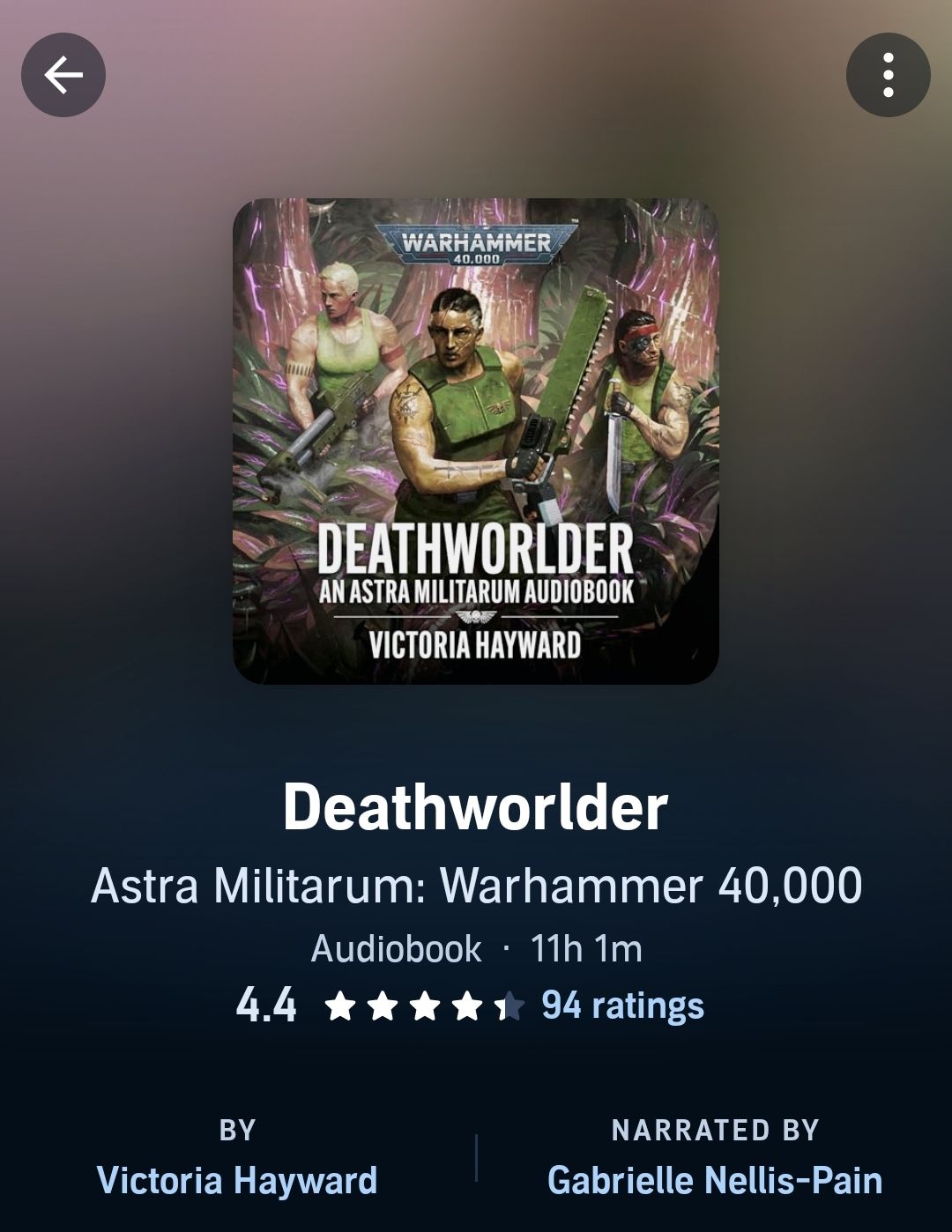
Deathworlder is another book following the Astra Militarum. This time, it’s one of the famous Catachan regiments under the microscope.
I like reading/listening to stories about the Astra Militarum because it shows what life is like for the “ordinary soldiers” in the Warhammer 40k universe, which is this vast, slightly jumbled and chaotic setting. With so much going on and the odds seemingly against the Astra Militarum as they struggle through a bit of a blender that is galaxy-wide, nonstop war.
The galaxy is full of weird and dangerous aliens, that might give some eldritch horror a run for their money, so to have these sorts of stories of ordinary humans fighting to protect humanity from the wider threats that they face is endearing. Warhammer 40k might notice I’ve got a bit of a soft spot for the Astra Militarum, and they would be absolutely correct.
In Deathworlder, we join the Catachan 903rd as they hold one final bastion against the Tyranids, an alien species controlled by a “hive mind” that devours everything biological to collect biomass to create more Tyranids. The story revolves around Major Wulf Khan, as she is ordered to take a squad of soldiers to investigate a possible weapon that many hope will be able to stop the inexorable consumption of the Tyranids. Although they discover that the weapon isn’t what they think it is, the journey to get to the facility where it is being held is fraught with danger and intensity, with many close calls along the way.
Now we move on to the Space Marines. These are the Imperium’s elite super soldiers. These genetically engineered and modified soldiers are giants among men, quite literally!
Space Marines are grouped together in “Chapters”, roughly 1000 marines in size, the Charcaradons are one such Chapter. A lot of Chapters are based on groups of people throughout history, the Charcaradons inspired by Pacific island Indigenous people, and many of their traditions are mirrored by the Space Marines.
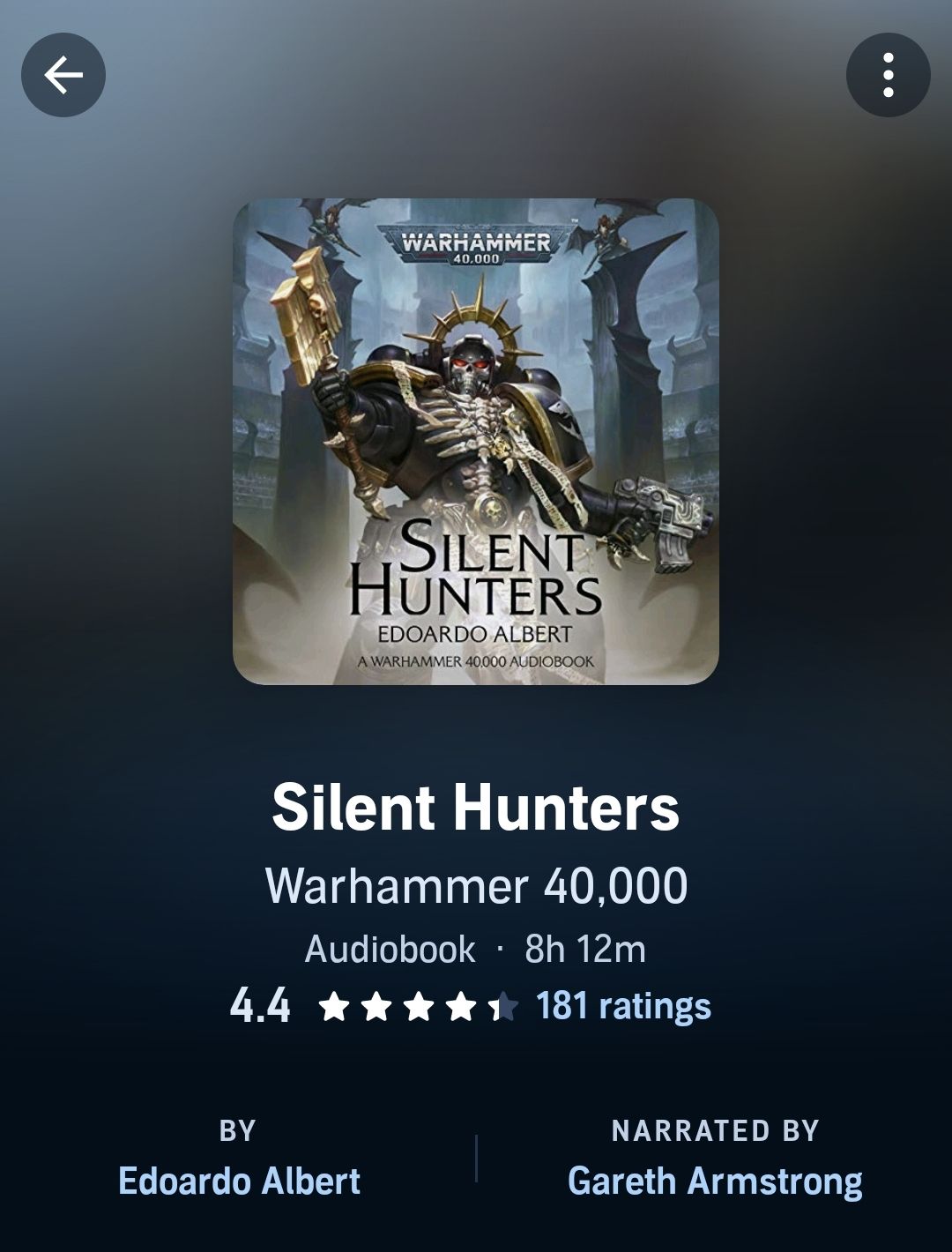
At the start of Silent Hunters, an artefact of the Charcaradons is stolen and must be returned to the chapter. During their mission to retrieve their lost artefact, they stumble upon a young boy, being protected by his mother, who has unusual powers (in the Warhammer 40k universe, this is seen as a bad thing, sort of, it’s complicated). They must also travel through the Webway to find it. The Webway is an interdimensional transit system/realm/dimension of its own.
Anyway, before I get too lost in the rabbit hole that is the lore of Warhammer 40k, I’ll move on to why I enjoyed this book. The Carcharadons are a bit of a mystery in Warhammer 40k; their origins are a bit murky, and why they tend to stay to the fringes of space is semi-forgotten by time and history. Having that element of mystery is really intriguing, and the characteristics of the Charchadons and how they think and operate really drew me in, in a way that some other Space Marine Chapters don’t (a lot of them are a little bit “vanilla” or plain). They’re also not on some quest for repentance like other isolated Chapters often are; they were given a task and will only return to the fold when they have completed that task to their satisfaction.
The Carcharadons are also not as flamboyant and boisterous as other Chapters; they are stoic and quiet. They fight in complete silence, and that adds an element of unease which I find really interesting, because it breaks some of the in-universe stereotypes of how Space Marines are supposed to be.
In Silent Hunters, the Charcardons are up against the Drukhari (AKA Dark Eldar AKA evil space elves). They must travel to the city of Commoragh, in the webway, to retrieve something the Drukahri stole from them. The way they did this on their own with little to no outside help was quite resourceful, as they are often forced to be.
The characters are quite interesting, and how the Space Marines interact with the “normal” humans who tag along on their mission shows a different side to the Charcaradons.
The story has a good pace to it, and it doesn’t rely on a sort of “false jeopardy ” where it feels like the odds are too insurmountable, but they succeed anyway that is sometimes present in Warhammer40K stories. The Charcaradons come across as quietly competent and following and executing their plan.
The Charcaradons are known as a “Fleet-based Chapter”, meaning they don’t have a world to call home and tend to keep themselves to themselves on the fringes of known space. This means they have to perform ceremonies called the “Red Tithe” to collect more recruits to keep their numbers at an effective level and the “Grey Tithe” to collect resources like ammo and armour.
In Red Tithe, the Charcaradons must find new recruits. Their recruitment differs from other Space Marine Chapters due to the fact that they don’t have a “home world” to draw fresh recruits from, so they have to take them from planets in the imperium.
Their chosen planet this time round is a prison/mining planet called Zartak. Prisoners are forced to mine raw materials for the imperium. It is a planet they have tithed before, but this time, they have competition.
The Night Lords are traitor Space Marine Legion who turned their backs on the imperium 10,000 years ago. They have also come to Zartak for the same purpose, to recruit for their warband. There is also a more sinister plot as one of the warband wishes to summon a demon from the warp.
One particular prisoner is unaware of his importance to both the Charcaradons and the Night Lords, as his psyker abilities can swing the balance in favour of one side or the other. With both sides looking to acquire his abilities, he has to try and escape.
This was quite interesting to listen to as part of the Charcaradons’ mysterious beginnings are potentially tied to the Night Lords, and their fighting styles are similar. So, to have a crossover between the two and hear they compare head to head.
As I’ve said previously, I find the Charcaradons really interesting and Red Tithe adds to that as well learn more about how and why they operate the way that they do. Hearing about their motivations and justifications was cool, and the satisfaction of them overcoming the hurdles that they faced to achieve the goals was gratifying.
The final book on this list is another Charcaradons book. Yes, I went into a bit of a hyperfocus on the Charcaradons, I’m autistic. That’s what we do sometimes!
The Outer Dark has the Charcaradons facing up against the Tyranids, an alien race that is akin to a swarm of large carnivorous insects being led a central intelligence, called “The Hive Mind”, that consumes all biomass in order to create more Tyranids and to help them evolve new forms of Tyranids.
The Tyranids are one of the biggest threats to the galaxy in warhammer 40k as they wish to consume all life, but the Charcaradons have been fighting them for a long time and are experts at defeating them.
Up against a large splinter fleet of the Tyranids, the Charcaradons must decide when and where to set up a bulwark against the aliens to prevent them from eating and tearing their way through a large section of the galaxy. They must also decide if they should trust a fellow exiled chapter of Space Marines to offer aid when the time is right, based on old agreements and continued trade.
The planet they decide on is Piety V, a shrine world to the emperor of mankind. They believe the Tyranids will hit this world hard and use it as a springboard to delve deeper into imperial space. While preparing their defences and the population for the invasion, they discover a cult on Piety V that are set upon attracting the Tyranids towards the planet as quickly as possible.
The Charcaradons must act quickly to stamp out this insidious plot if they are to save the planet from being devoured. With the odds stacked against them planetside as the cult reveals just how deeply infiltrated the positions of power in the planets government and the fleet up in space growing larger and larger, The Charcaradons have to dig deep to buy themselves time, in the hopes that reinforcements turn up as promised.
In Outer Dark, I did feel it was a bit more tense, as there’s a lot going on, and there seemed to be a smaller guarantee of success for the Charcaradons without outside help, but did find the ending quite satisfying.
So there’s the list of audiobooks that I enjoyed last year. It’s taken me a bit longer to write this blog because I had to revisit some of them to remind myself of what happened in the books. But anyway, here it is finally! I hope you enjoy it.







 Duncan Ainsworth